Monday, April 22, 2013

The Rise of Reagan and the Legacy of the New Conservatism

The aftermath of the Nixon Administration left many things in doubt, however, the growing conservatism of the nation was not one of them.  As much as the Vietnam War forced America to re-evaluate its military role in the world, as much as student protests and the Hippie Movement brought forward a strong counter-culture awareness that belied the cookie-cutter/Leave It To Beaver simplicity of the 1950s, and as much as the rise of the Middle East and of Japan, South Korea, and China as emerging powers called into question the economic influence of the United States, the country itself was clearly on a trajectory of greater and greater social conservatism - in time, this social tendency would become reflected politically and economically.
 
Discuss the administrations of Ford, Carter, Reagan, Bush 1, and Clinton in terms of their political response to the social and economic demands of the conservative electorate that was largely identified by Nixon back in the 1950s and then cultivated by the Nixon administration from 1968-1974.  What were the major issues and proposed solutions that emerged from the American people in response to both domestic and foreign concerns.  How did each of these presidents attempt to respond and perhaps lead this push by The People.
 
Clearly identify the major social, political, and economic concerns that characterize this time period of growing conservatism in America.  Contrast it with the recent very liberal period groing back to FDR.
 
DUE DATE: Monday, April 29, 2013 by midnight
 
Word Count: 1,000 words minimum


From Open Skies to a New Frontier to a Great Society: Ike, JFK, and LBJ

  
Discuss the evolution of American Society from 1955 to 1968 by focusing on the major social, political, and economic concerns that affected life on the homefront.  Make use of the essay at the end of Chapter 38 to evaluate the 1960s and whether or not they were a constructive time period or a destructive one, or, perhaps, a combination of both (remember, sometimes in order to build, you have to tear down, and sometimes one tears down in order to open the possibility for new building later).


As part of your discussion, evaluate each of the three administrations for their strengths and weaknesses, the things they got right and the things they got wrong.  So, frame your discussion of American Society in terms of these three administrations: a paragraph at least about Ike, then about JFK, then about LBJ.  It may prove useful to extend your frame outward a few years on each end to include the influence of Truman and Nixon as the bookends of this time period.
 

DUE DATE: Friday, April 26, 2013 by midnight

Word Count: 1,000 words minimum


Monday, April 8, 2013

The Little Rock Nine, Federal Authority, and Civil Rights


On September 24, 1957, in response to the use of the Arkansas National Guard by Governor Orval Faubus to prohibit the entry of nine African-American students from physically entering Central High School in Little Rock, Arkansas, President Dwight D. Eisenhower ordered the 101st Airborne (an elite military force that gained fame for taking down Hitler's forces in Europe during World War II) into Arkansas while simultaneously federalizing all 10,000 National Guardsmen in the state to make sure that these nine students could safely enter the school, attend classes, and then leave school unmolested by protesters.  This was a singular event in American History, seen by some as the fulfillment of the words of Thomas Jefferson nearly two hundred years earlier that "all men are created equal," while to others it was seen as the embodiment of an over-reaching and perhaps tyrannical Federal government now taking charge of public education which had long been a states' rights concern historically.

In class, we investigated the story of this event through several documents.  Your task, now, is to use those documents and any and all relevant and concise outside information (historical from lectures, from the history book, from documentaries, from works of literature, etc.) you can muster to answer the following prompt from an FRQ on the 1999 APUSH Exam:

How did the African-American Civil Rights Movement of the 1950s and 1960s address the failures of Reconstruction?

Make use of all of the documents and the information from Chapters 37 & 38 as well as looking back at your notes and other materials relating to Reconstruction (Chapter 22).  Although this is an FRQ prompt, I am requiring that you treat it as a DBQ exercise, so be thorough in your synthesis of the information, but also be concise.  It will be important to address the role and growing power of the Federal Government and the example of the Little Rock Nine in your response.

DUE DATE:  Monday, April 15, 2013 by midnight

Word Count:  1,000 words minimum
Key Ideas & Terms to help focus your response:
Dred Scot Case
Plessy v. Ferguson
Brown v. Board of Education
Emancipation Proclamation
13th Amendment
14th Amendment
15th Amendment
Freedman's Bureau
Radical Republicans
Southern Democrats
Jim Crow
KKK
NAACP
SNCC
Freedom Riders
Rosa Parks
March on Washington
Black Panthers
Martin Luther King, Jr. v. Malcolm X

Wednesday, March 20, 2013

FDR: The Greatest President?

Over the course of American History thus far, we have stopped to consider the significance of certain presidents such as Washington, Jefferson, Jackson, Polk, Lincoln, and Teddy Roosevelt.  Each of these men has a certain claim to being remembered for the positive impact that each has had on American History, either immediately at the time of their service, or later as the results of their efforts and policies have ripened and brought forth fruit.  None of them, however, has had the public appeal and lasting influence of Franklin Delano Roosevelt, a man who certainly felt a call to destiny, and a man who, despite his paralysis from polio, inspired others to rise to the multiple challenges facing the country (Great Depression, Fear of Fear Itself, Lingering Recession, Pearl Harbor, the War in Europe, the War in the Pacific, etc.) over the twelve-plus years in which he presided in the White House.  As far-reaching as his cousin's, Teddy Roosevelt's, presidency was, it is indisputable that the shadow of influence that is cast by FDR still hangs over presidents today.

Consider each of FDR's separate terms in office (1933-37; 1937-41; 1941-45; 1945) and sumamrize the major accomplishments (social, political, economic, etc.) and major failures (social, political, economic, etc.) in each.  Then, determine to what extent it can be said that FDR was or was not the greatest of American presidents up to his time.  This will require you to re-evaluate some of our past presidents so that you can convincingly argue for or against one of them in favor or not of FDR.

Your response will necessarily need to be at least seven (7) paragraphs in length (Introduction, First Term, Second Term, Third Term, Fourth Term, Evaluation, Conclusion) and will need to incorporate comparisons to previous administrations and their claims to greatness.

DUE DATE:  Monday, April 8, 2013

Minimum Word Count: 1,000 words

Tuesday, February 26, 2013

The Legacy of Teddy Roosevelt


This blog is essentially a review of the information in Chapter 28 and how it will impact American History up to and through the 1920s (Chapters 29, 30).


"When I say I believe in a Square Deal, I do not mean...to give every man the best hand.  If the cards do not come to any man, or if they do come, and he has not got the power to play them, that is his affair.  All I mean is that there shall be no crookedness in the dealing."

Theodore "Teddy" Roosevelt was perhaps the single most defining President since Lincoln, as Lincoln was since Jackson, and Jackson since Washington.  He was dynamic and forceful, a man who felt the weight and majesty of destiny, a man who would make America what it should be no matter what.  However, he was also a man whom others felt threatened by, a man who was perhaps too consumed with his desire to "do, do, do!"

As you look over Chapters 28-30, consider the impact that Roosevelt had at first, and the long shadow of influence that his example cast over future Presidents and America itself.  To what extent was Teddy Roosevelt a great President who mastered the major issues of his time, and to what extent did his performance shape and define the Presidents after him and the country's view of itself, too.

DUE DATE: Monday, March 4, 2013

Word Count: 500 words minimum

Quick Facts on His Life & Presidency:
http://millercenter.org/president/roosevelt

The Teddy Roosevelt Center:
http://www.theodorerooseveltcenter.org/

The White House:
http://www.whitehouse.gov/about/presidents/theodoreroosevelt


Thursday, February 7, 2013

The Roosevelt Thesis: America Had Become Effeminate

In addition to having been the Assistant Secretary of the Navy under McKinley, Governor of New York, and then running mate to and Vice President of McKinley, followed shortly after once McKinley was assassinated by becoming President of the United States, Theodore Roosevelt was also an historian who posited an interesting and controversial thesis about why America did what it did in the late 1800s and early 20th century.  In short, Roosevelt had asserted that America had become too soft, to complacent, to effeminate over the course of the Gilded Age.  You have seen now that the time period from 1865 - 1900 was filled with many and diverse competing interests, from Reconstruction and how to faciliate it, to the rise of a Populist Party from the persistent monetary and financial issues that shaped the West and reflected the interests of the East, to the resurgence of Women for their rights and how that would sweep like a backlash from West to East instead of East to West, to the fate of the former slaves, Chinese, Japanese, Eastern Europeans, and Native Americans in all areas of the growing country.  On top of all of this was the rise of Billionaires and their massive industrial and financial monopolies which were supported by the Federal Government over the plight and desperation of the labor force.  And then there were the financial panics and the deep recession of the 1890s.

To what extent do you agree or disagree with Roosevelt's thesis that America had become too "womanly" or soft by the late 1890s and thus the territorial conquests of 1898 and their after effects were necessary to restore American vigor and manliness?  Include in your answers such topics as diplomacy, the Panama Canal, the Roosevelt Corollary to the Monroe Doctrine, and such groups as women, blacks, Native Americans, Cubans, Puerto Ricans, Filipinos, and Hawaiians to contest or support his assertion that such groups were bound to be conquered by WASP America.

Refer to American Pageant pp 646-653.

DUE DATE: Monday, February 11, 2013 by midnight

WORD COUNT: 500 words minimum

Thursday, January 31, 2013

The Spanish-American War: Ambition or Destiny?


The Spanish-American War is a controversial topic in American History, then and now.  At the time it was seen by many as the result of the ambitions of a handful of men (Teddy Roosevelt, Henry Cabot Lodge, John Hay, Elihu Root, and Alfred T. Mahan) and their shared vision of America as a world power to be reckoned with, while it was seen by others as the fulfillment of Manifest Destiny and the natural or divine role of the United States of America in the world at large.  Both camps could and did subscribe to the observation of the historian Frederick Jackson Turner that America's rise to power and influence was due to the frontier that had always attracted explorers and pioneers, settlers and entrepreneurs.  The question was, however, with the frontier gone, what would happen to the United States of America?  Would it enter into the world through the efforts of a few or would it emerge as a major power as a matter of course?  Was America to be the consequence of ambition or of destiny?

Discuss the circumstances, persons, and consequences of the Spanish-America War with regard to the concepts of ambition and destiny.  To what extent was America's future determined by the desires of a few men or the natural course of its own sense of destiny?

Make use of the links I have provided on Edmodo regarding the Spanish-American War (uploaded Jan. 30, 2013 to APUSH), especially the PBS video Crucible of Empire and its accompanying webiste, to formulate your response.

DUE DATE: Monday, February 4, 2013 by midnight

WORD COUNT: 500 words minimum

RHETORICAL DEVICES: make sure you identify at least five rhetorical devices that you use in your own writing by identifying them by name in parentheses after each example.

Friday, January 25, 2013

The Continuous Recession: Indian Removal & The West


"We took away their country and their means of support, broke up their mode of living, their habits of life, introduced disease and decay among them, and it was for this and against this they made war.  Could anyone expect less?"  - General Philip Sheridan, United States Army (1878)


The fate of Native Americans as the United States continued to grow across the continent can be seen as one of a "continuous recession" through direct and indirect policies not only of the Federal government but also of white settlers and business interests themselves.  In reading over Chapter 26 (especially pp. 594-604, click HERE for the powerpoint), identify the major themes, individuals, and incidents that support the claim that the Native Americans were systematically, whether through actual policies or accidental consequences or both, forced further and further from their traditional ways, thereby experiencing a "continuous recession" of their cultures and their importance relative to the Federal government and the white settlers around them.  Begin with a complex-split introductory paragraph, and then provide at least one, well-developed body paragraph in which you identify and discuss the themes, individuals, and incidents that support the claim.

I have provided three additional links to more information to help you broaden your response and your understanding of this issue in American History.

DUE DATE:  Monday, January 28, 2013 by midnight

WORD COUNT:  500 words minimum

The Indian War:
http://www.history.org/foundation/journal/spring10/war.cfm

The Thirty Years War:
http://www.digitalhistory.uh.edu/disp_textbook.cfm?smtID=2&psid=3499

Reporting the Indian Wars:
http://www.encyclopedia.com/doc/1G2-2536601590.html

Tuesday, January 15, 2013

Radicals or Revolutionaries?

Reread the Varying Viewpoints Essay on p.529 in your American Pageant and then compose an argument that compares and contrasts the views of at least two of the historians discussed in that essay - you will need to do some research on the internet to find more specific information about each historian and work that is cited in the essay.  If you try to base your argument solely on the limited information in the essay itself, then you will end up with a VERY weak essay that may only score as high as a 2 or 3 on the 9 point scale.  Evaluate the extent to which each historian's view is potentially historically valid, and then the extent to which there are problems with that view that do not seem to fully address the significance of the Populists and the Populist Movement during the Gilded Age.  As before, identify and label at least one rhetorical device that you use in your argument (if you want to track more than one, please do so since the more practice you have at identifying and labeling your own, you will be that much better prepared for the AP Exam in May).

Historians in the Essay:
Charles and Mary Beard - The Rise of American Civilization (1927-42)
Vernon Louis Parrington - Main Currents of American Thought (1927-30)
John D. Hicks - The Populist Revolt (1931)
Richard Hofstadter - The Age of Reform (1955)
Lawrence Goodwyn - Democratic Promise: The Populist Movement in America (1976)
Edward L. Ayers - Promise of the New South (1992)
Robert C. McMath - American Populism (1993)

DUE DATE:  Monday, January 21st by midnight

Word Count: Minimum 500 words

Friday, January 11, 2013

The Gilded Age: Was It Only A Time of Corruption?


The timespan from 1872 - 1900 is characterized by a series of "Forgettable Presidents" whose administrations contended with rampant political and economic corruption by members of their cabinets, members of Congress, railroad barrons, and stock speculators to name the most prominent.  Explain the metaphor that Mark Twain coined to describe this time period, that this was the "gilded age" - what was the thin layer of value covering what depth of corruption?  In your response, explain the extent to which this time period was corrupt and in what ways it had redeemable qualities.  Use specific examples from Chapter 23 to develop your response.

Remember, too, that I am will be assessing you on your use of at least one correctly used and correctly identified rhetorical device in your response.  In order to ensure that I grade you correctly, you need to identify the device that you use by bolding it.  If you do not do this, I will not be able to give you full credit for your response.

DUEDATE: Monday, January 14, 2013

Word Count: 500 words minimum

Series of Videos on Youtube Covering Major Aspects of The Gilded Age:
http://www.youtube.com/watch?v=d0bwcppAGFc&playnext=1&list=PL67928E6ED0A35DA0&feature=results_main
 

Wednesday, December 5, 2012

Would Lincoln Have Mattered?


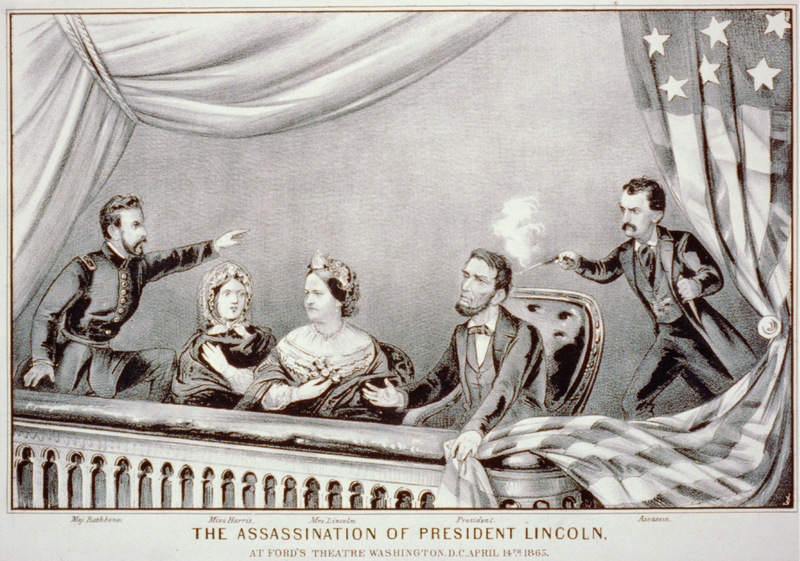
The Reconstruction of the South following the Civil War, and perhaps most influenced by the assassination of Lincoln, which infuriated the Radical Republicans and has largely been seen by most historians as the greatest misfortune to befall the South because now there was vengeance in the eyes of many Northerners, is the topic of this blog.  In looking back over Chapter 22, explain the key factors that defined both the successes and failures of Reconstruction.  As you determine the specific social, political, and economic factors that one could use to frame an argument about the good and the bad aspects of Reconstruction, consider the question posed in the title of this blog, "Would Lincoln Have Mattered?"  That is, would Reconstruction have happened in a fundamentally different way, perhaps better, if Lincoln had not been killed?  That, in and of itself, begs a further consideration:  what ifluence would Lincoln have had if he had merely been wounded and not died?  What if he was mentally crippled from the headshot and survived?  What if John Wilkes Booth had been stopped before he even entered the Presidential Balcony at Ford's Theater, and so Lincoln would never have been shot?  So, consider the history of Reconstruction as it happened as well as how it might have happened if Lincoln had survived and in what condition.

DUE DATE:  Friday, December 7 by midnight.

WORD COUNT:  500 words

Monday, November 26, 2012

Popular Sovereignty or Freedom?


The growing tensions between the North and the South, especially with the South's insistence on being provided security for the institution and perpetuity of slavery, had created a situation in which compromise was becoming harder and harder to make.  The 3/5ths compromise back in 1789 with the Constitution had led to the closing of the African Slave Trade by 1808 by giving the South the voting power to offset that of the North in the House of Representatives.  The Missouri Compromise had maintained this balance of voting power by giving a large chunk of northern territory to the slavery interests with the understanding that there would be no more slavery north of the Missouri Compromise Line from that time forward.  However, as it became clear that the newly acquired American Southwest was inhospitable to big plantations and therefore slavery, there was renewed efforts by those in the South to get ahold of more northern territory using the persistent threat of secession to force the North to agree since most in the North believed in the Union more than they believed in either States' Rights or the abolition of slavery.  Thus, the Compromise of 1850 and then the Kansas-Nebraska Act in which the notion of "popular sovereignty" or "let the people choose" became the means by which Congress could avoid having to make the decision itself.  Indeed, many had called into question whether or not Congress had the power at all to legislate on slavery (either for it or against it or anything inbetween)!  Finally, in a speech given in Peoria, Illinois in 1854, Abraham Lincoln (who would eventually become President in 1860) made the following point in his debates with Stephen Douglas, the "cheerleader" as it were of "popular sovereignty":

The doctrine of self-government is right - absolute and eternally right - but it has no just application, as here attempted.  Or perhaps I should rather say that whether it has such application depends upon whether a negro is not or is a man.  If he is not a man, why in that case, he who is a man may, as a matter of self-government, do just as he pleases with him.  But if the negro is a man, is it not to that extent a total destruction of self-government, to say that he too shall not govern himself?  When the white man governs himself that is self-government; but when he governs himself, and also governs another man, that is more than self-government - that is despotism.  If the negro is a man, why then my ancient faith teachers me that "all men are created equal," and that there can be no moral right in connection with one man's making a slave of another.

Evaluate Lincoln's argument here and contextualize it with regard to the history of compromises made for the benefit of the South at the expense of the Union and its founding ideas of "We the People" and "All Men Are Created Equal."  Show the evolution of Lincoln's point that slavery  actually promotes anti-self-government by showing how these several compromises over history up to 1854 lead to the crisis that the Kansas-Nebraska Act was intended to solve.

DUE DATE:  Friday, November 30 by midnight.

Word Count:  500 words minimum


Thursday, November 8, 2012

Andrew Jackson's Legacy


We have talked in class at great length about the importance of Andrew Jackson not only in his own time but after as well.  In so many ways he shaped and defined the America we now have, from the idea that the average person has a place in government to the distrust of centralized banking.  He was a man torn by personal loss and driven by personal rage, but also a man who simply did not ever give up on anything.  From arming free-blacks in New Orleans in 1815 to forcing the relocation of thousands of Native Americans in 1839, Andrew Jackson is also a man of contradictions that make it nearly impossible to come to a final and perfectly clear portrait of him either in or out of the White House.

Revisit Chapter 13 and the essay on pp.285-86 entitled What Was Jacksonian Democracy? and explain why it is that Jackson is so important to American History.  Compose this response as a summation of everything you believe is crucial to know and understand (knowing a fact is different than understanding its importance) about Andrew Jackson and his impact on American History.

DUE DATE:  Sunday Night, November 11 by midnight.

Minimum Word Count:  500 words

Andrew Jackson (White House):
http://www.whitehouse.gov/about/presidents/andrewjackson

Andrew Jackson (The Hermitage):
http://www.thehermitage.com/jackson-family/andrew-jackson

Andrew Jackson (PBS):
http://www.pbs.org/kcet/andrewjackson/

American Pageant, Ch. 13:
https://docs.google.com/file/d/0B06Mqo8bYnzgX3hrc0lLVGlqX28/edit

Wednesday, October 31, 2012

How I Would Vote And Why - Reflection on Electoral College Assignment

You have been tracking the polls and running scenarios for the upcoming Presidential Election next week and have seen how such an election is fundamentally a "numbers game" rather than a straightforward "whoever gets the most votes" thing.  The Electoral College was put in place to protect the new Executive Branch from the whims of the People who were not trusted to really know what was actually in their best interests.  Thus, there is the Popular Vote and then the Electoral College Vote.

If you were able to actually vote next week, for whom would you vote and why?  Make use of what you have so far learned about the first 18 Presidents and the challenges and obstacles that they each faced from 1789 through 1877 as indicated on your Presidents List.  Considering the present state of affairs as you understand them, how can the past help you come to a decision about who would make the "best" President for the next four years?

DUE DATE:  November 2, 2012 by midnight

Word Count:  300 words minimum

George Washington Music Video with Presidents 2-43:
https://www.youtube.com/watch?v=FZL-19wGnkA

Monday, October 22, 2012

J.Q. Adams vs. Jackson: The Birth of Modern Campaigning


The election of 1824 was fractious to say the least.  In a very important way, it was a defining moment in the evolution of our Constitutional democracy because it pitted the old, Eastern Establishment represented by Adams against the new, Western Anti-Establishment represented by Jackson.  The stakes for both interets were high, and though Adams would win this first "Bout at the Ballot Box" against Jackson, he would most certainly NOT win the second time around (the election of 1828) because of the unleashing of what we have come to call "Modern Political Campaigning."

Discuss the historical and literary context for what has come to be called "The Corrupt Bargain" that settled this election in the House of Representatives rather than at the ballot box.  Make use of the literature of the time to elucidate the American experience of politics at the time to help contextualize the historical information.

DUE DATE:  Friday, October 26, 2012 by midnight

Word Count:  300 words minimum

The election of 1824
http://presidentelect.org/e1824.html

The election of 1824
http://www.270towin.com/1824_Election/

The "Corrupt Bargain" of 1824
http://www.ushistory.org/us/23d.asp

Wikipedia article on election of 1824
http://en.wikipedia.org/wiki/United_States_presidential_election,_1824

Wednesday, October 17, 2012

Aaron Burr v. Alexander Hamilton


The ambitions and competitive natures of Aaron Burr and Alexander Hamilton seem to have directed these two founding fathers into a direct collision with each other.  Read the three articles about the duel provided below and reflect on the impact either of these men would have had if the duel would never have been fought.  What might have Burr become?  What greater impact might Hamilton have made on the country at large?  Discuss the lives of these two men and the circumstances that drove them into this duel, then specualte on what each of their lives might have been like had it never happened.  Begin with a complex-split introductory paragraph in which you identify three key ideas or themes or factors that A) led to the duel; B) resulted from the duel; or C) were a combination of precipitators and consequences.

DUE DATE:  Friday, October 19, 2012

Word Count:  300 word minimum

The Duel between Burr and Hamilton:
http://www.pbs.org/wgbh/amex/duel/peopleevents/pande17.html

http://www.eyewitnesstohistory.com/duel.htm

http://www.digitalhistory.uh.edu/learning_history/burr/burr_badblood.cfm

Infamous "Got Milk?" Aaron Burr Commercial:
http://www.youtube.com/watch?v=OLSsswr6z9Y

Tuesday, September 25, 2012

George Washington: Millionaire at Risk!


Discuss the social, political, and economic concerns that George Washington had in his rise to power and prominence in America from his early days to becoming the first President of the United States of America under the Constitution.  Be sure to deal with the impact of Shays' Rebellion on his thinking, especially about the need to address the weaknesses of the Articles of Confederation that would eventually lead to the creation of an entirely new form of government defined by the Constitution.

DUE DATE:  Friday, September 28, 2012 by midnight

WORD COUNT:  300 words minimum

Helpful Links:
http://www.whitehouse.gov/about/presidents/georgewashington

http://www.mountvernon.org/

http://www.pbs.org/georgewashington/

http://www.ushistory.org/us/15a.asp

http://shaysrebellion.stcc.edu/

Wednesday, September 19, 2012

A Conversation of Complaints: Native Americans vs. The Founders


Discuss the relations between the Native Americans and the Colonists from the early 1700s through the Revolutionary War and its aftermath by drawing upon the information from your American Pageant textbook (chapters 6, 7, and 8) and from your Norton Anthology (pp. 206-218) with special focus on Pontiac's Speech at Detroit and Red Jacket's Speech to the U.S. Senate and the Declaration of Independence (pp.342-346 Norton Anthology).  I am looking to see that you Assert, Prove, and Explain a position on this relationship (was it postive, was it negative, was it inevitable, was it avoidable, etc.).  Begin your response with a complex-split introductory thesis.

DUE DATE:  Friday, September 21, 2012 by midnight

Word Count:  300 words minimum

Monday, September 10, 2012

Puritan Worldview and the Salem Witch Trials

Discuss the relationship between the Puritans' (Separatists') worldview and the consequences of that worldview as exemplified by the Salem Witchcraft Trials 72 years after they first landed and established their colony of Plymouth. Draw upon information from your American Pageant textbook, from The Crucible, and from the links to additional materials below (since you do not have your Norton Anthology of American Literature, yet, I have included John Winthrop's A Model of Christian Charity below. Remember, The Crucible is not an historic document, it is a dramatization of the historical record, so be careful when you speak about it in your blog post. Remain "accurate" both in terms of history and literature.

DUEDATE:  Friday, September 14 by midnight.

Minimum Word Count: 300 words

http://www.britannica.com/EBchecked/topic/285064/Separatist

http://www.academicamerican.com/colonial/docs/winthrop.htm

http://en.wikipedia.org/wiki/Puritan

http://history.hanover.edu/texts/winthmod.html

Wednesday, September 5, 2012

Jamestown v. Plymouth

PocahontasWampanoag indians with pilgrims pictureCompare and contrast the settle-ments of Jamestown and Plymouth.  Include in your comparison the type of settlement each was, the kinds of settlers that established each, the purposes behind the founding of each, and the relationship each had with the Native Americans closest to each.  Include key historical figures so that you do not confuse the one with the other (for instance, Pocahontas and her story is associated with Jamestown, not Plymouth).


DUE DATE:  Friday, September 7, 2012

Minimum Word Count: 200 words